

I Want to Install Hydropower

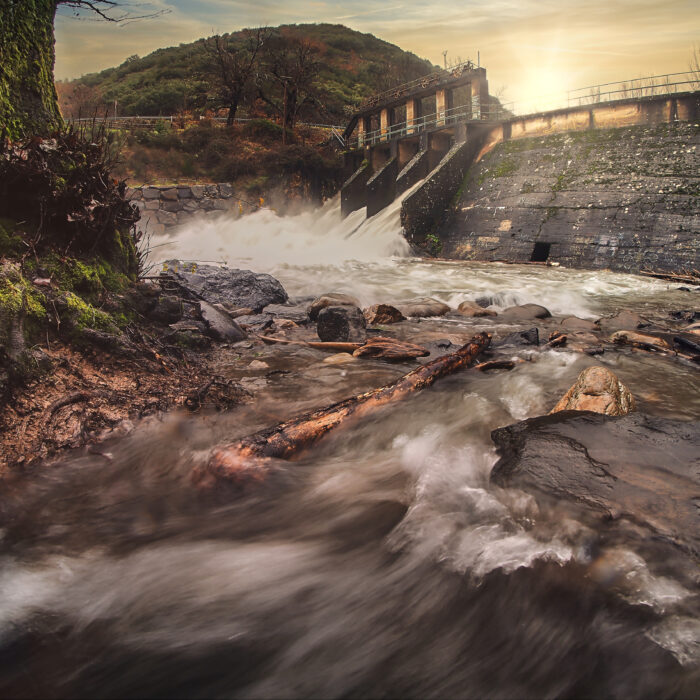

Flowing water has potential energy that can be harvested as it flows downhill. Mini hydro power systems convert the potential energy in small streams and waterways into kinetic energy via a mechanical turbine, which drives a generator to produce electricity. The greater the drop and quantity of water there is flowing through the turbine, the more electricity can be generated.
Click on the ‘Mini Hydro Guide’ below to download a detailed overview with all you need to know about installing a scheme
This guidance was released in 2016 by the EA to help developers understand the environmental protection safeguards needed when designing and installing a hydropower scheme.
Hydroelectric power is generated using flowing water to spin a turbine. The turbine’s shaft is connected to an electric generator where electricity is generated using the rotation to spin magnets in coils of copper. The water is controlled through a sluice gate which can be lifted or lowered to allow more or less water to flow through the turbine.
The amount of power a site can generate depends on how much water there is and how great a fall there is.
Power (in kW) = Water Flow (in cubic metres per second) × Head (in metres) × Gravity (9.81 m/s²) × Efficiency (%)
If there are 1,000 litres flowing over 10 ms of head:
10 m × 1 m3 × 9.98 m/s × 0.75
Power = 75 kW
75 kW scheme operating at a 40% capacity factor:
75 × 8,760 (number of hours in a year) × 0.4 = 262 MWhs pa
or about 100 houses using on average 2,500 kWhs pa.
This is very site-dependent, but a very rough rule of thumb is ~ £8,000 per kW capacity for smaller sites or £4,000 per kW capacity for a larger system (high head), but there is huge variation from one site to another. Low head sites can be more expensive due to the higher amounts of civil works costs (a larger volume of water means a larger turbine).
The capital costs will include:
• Turbine and all the drives, generators and valves
• Controls
• Pipe costs and welding works
• Civil works to create the intake, screens, pipeline and the turbine house
• Electrical works within the turbine house plus transformer if required
• Connections costs, including any upgrading of the grid if required
• Any new access tracks and routes to the abstraction point
• Design and licence fees
On average, 70% of the cost of a new UK hydropower scheme is in civil construction, which can often be procured locally.
There are no UK-wide grant schemes or generation tariffs for hydropower. There may be local grants available to community groups.
The Smart Export Guarantee (SEG) launched on 1 January 2020 and requires some electricity suppliers to pay small-scale generators for low-carbon electricity they export back to the National Grid, providing certain criteria are met. Currently, this is very low at ~ 4p/kWh for every unit of power you export.
If your scheme is generating electricity that will be consumed on-site, and therefore displacing imported electricity, this can offer the best value.
A grid connection must be arranged with your local Distribution Network Operator (DNO). Network capacity is scarce in certain parts of the country and should be assessed and reserved as early as possible to prevent delays to any project.
The costs of grid connection are site-specific, but the main variables influencing cost are: connection voltage; physical location and access to the network; network capacity and availability; upgrade requirement, if any; and generation technology.
The costs vary between DNOs and also depending on the connection voltage. Design fees vary between a few hundred pounds for small low-voltage connections and several thousands for connections to the 33 kV network.
The DNO has a three-month period to design and cost an appropriate connection. The DNO will also identify the contestable and non-contestable works.
Once the design is complete, contracts are signed. In addition, Use of System Agreements will have to be signed for the export of electricity to the network.
Typically, one or more licences will be required from the Environment Agency (EA) in England, the Scottish Environment Protection Agency (SEPA) or National Resources Wales (NRW). Planning permission is also often required as well. We would recommend consulting the local authority and EA, SEPA or NRW as soon as the technical viability of a project has been established.
The main costs will include the following:
• Business rates, which will be charged unless it is seen as a domestic installation
• Insurance
• Operation and maintenance
• Replacement of key parts after approximately 10–15 years
With hydropower there is no standard solution. The best design for a site is often not obvious. It is important to take advice at an early stage from someone with experience and a good track record. Ask for references or information on working installations – hydropower schemes should last for a long time.
Look at our list of consultants and advisers and get in touch if you need more information.
The BHA organises a range of events every year to bring together the hydropower industry to network and share knowledge, innovations and opportunities.
View All Events
British Hydropower Association Supply Chain Market Opportunity Event, Dinner & Exhibition Wednesday 9th September Kimpton Clocktower Hotel, Oxford St, Manchester M60 7HA The UK hydropower sector is entering its…
Read More
Working together for more sustainable rivers in Northern Ireland Wednesday 7th October 9am – 5pm Dunsilly Hotel, 20 Dunsilly Rd, Antrim BT41 2JH Our Aim To bring together regulators,…
Read MoreSign up and stay informed with the latest updates in the hydropower sector.
